



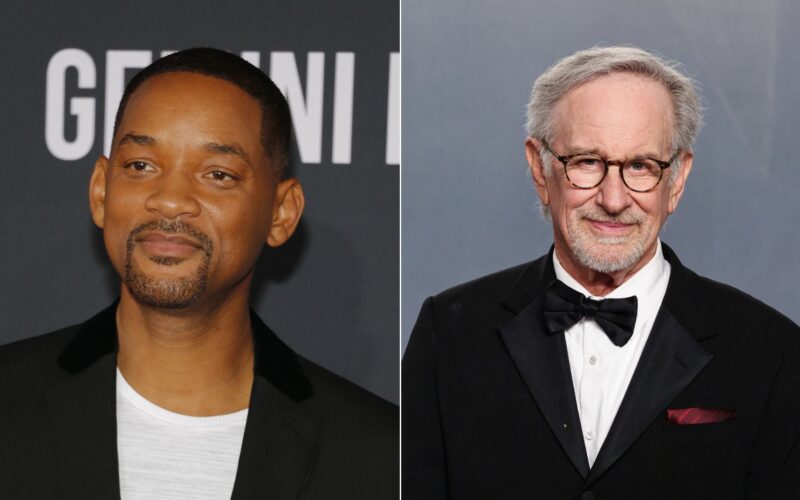
Will Smith was already one of the biggest stars in Hollywood when he decided to ask Steven Spielberg a question that had clearly been sitting with him for a while. Why had Spielberg never cast him in one of his movies?
What came back was not the kind of answer most actors would want to hear.
According to Smith, the two were at a party when he finally asked Spielberg why they had never worked together. Spielberg’s response was short, blunt, and apparently unforgettable. “Oh, you’re too big for my movies.”
At first, Smith said he did not even know how to take that. He joked to himself about whether Spielberg meant his height. But the real meaning hit later, and it hit hard. Spielberg was not talking about size. He was talking about Will Smith, the celebrity.
Spielberg’s Comment Made Will Smith Rethink Everything
That one line forced Smith to look at himself in a very different way. He realized the image he had built, the charm, the swagger, the larger-than-life persona, had grown so massive that it could pull attention away from the actual character on screen.
In other words, audiences were not always seeing the role first. They were seeing Will Smith.
That kind of realization can mess with a star, especially one who spent years being the guy studios could count on to open a movie. Smith later admitted that the persona he created had become too big for some of the stories he wanted to tell. Instead of disappearing into a part, he had started overshadowing it.
And for an actor trying to be taken seriously, that is a brutal thing to hear.
The Career Shift That Followed
That moment seems to have pushed Smith into a different phase of his career. Instead of just chasing giant commercial hits, he started leaning toward roles that demanded more vulnerability, more transformation, and less pure movie-star energy.
He pointed to ‘The Legend of Bagger Vance’ as a turning point. Directed by Robert Redford and released in 2000, the film was not exactly a huge win at the box office, but for Smith, it marked something bigger behind the scenes. He said it was the first time in his career that he fully surrendered his instincts and allowed himself to be shaped by a director instead of driving everything through his own star power.

How Will Smith Went From Mega-Star to Oscar Contender
Fans eventually saw the result of that change in films like ‘Ali’, where Smith took on Muhammad Ali in a role that required intense physical training and a far deeper dramatic reach. The 2001 film earned him his first Academy Award nomination and showed Hollywood he was not just the wisecracking blockbuster guy anymore.
Then came ‘The Pursuit of Happyness’ in 2006, followed years later by ‘King Richard’ in 2021, the role that finally won him an Oscar. Those performances worked because the character came first. The celebrity aura did not vanish completely, but it stopped swallowing the material whole.
That is what makes Spielberg’s comment so juicy in hindsight. It was harsh, but it may also have been the wake-up call Smith needed.
And honestly, it says a lot about Hollywood. Sometimes the very thing that makes a star huge is the same thing that keeps certain directors at a distance. Being too famous sounds like a compliment until it starts costing you parts.
For Will Smith, that moment was clearly a turning point. Spielberg may have said no, but the reason behind it appears to have changed the way Smith approached acting from then on.